
6.1 The Rules of Magic
Some characters have access to powerful magic that allows them to deal damage, buff their allies, hinder their enemies, or change the battlefield around them. Some characters will gain access to magic through class advancement, while some were just born with the gift.
There are two branches of magic subdivided into many schools. Magica stems from the positive energy in the world and relies on one’s ability to focus and bend it to your designs using Will. Malika stems from the negative energy in the world and draws directly from your lifeforce. Most magic users will rely on the prior form of magic, but access to Malika can grant abilities both powerful and unnatural.
Design Note
Structuring magic in this way allows us to implement very powerful magical abilities as Malika, but pair them with significant risk. Malika will require the user to risk their own Health to successfully cast, making these spells a careful balance of risk and reward.
All magic is subdivided into schools. Each school of magic focuses on a single concept. Schools of magic are organized into five different tiers representing more powerful manifestations of the same magic. Each level requires more of the user to manifest that effect.
In general casting magic of any kind will follow these steps:
- Choose a primary school of magic that is the baseline for your spell.
- If desired, choose a secondary school of magic to modify the spell
- Choose a tier (1-5) for your spell.
- Make a spellcasting check to see if you are successful at manifesting the spell.
- If successful the target(s) of the spell may choose to attempt a check to avoid the effects of the spell.
- If the target(s) fail their check or decline to make one the spell takes effect.
Casting a Spell
Casting higher tier magic is more dangerous and more costly than lower tier magic. Manifesting a spell requires a spellcasting check. The table below demonstrates how the spellcasting check DC and point cost scales with spell tier.
| School of Magic | ||
|---|---|---|
| Tags | [MAKICA], [ATTACK], [DAMAGE TYPE] | |
| Tier | Spellcasting DC | Cost |
| 1st | 2+ | 1 pt. |
| 2nd | 3+ | 2 pts. |
| 3rd | 4+ | 3 pts. |
| 4th | 5+ | 4 pts. |
| 5th | 6+ | 5 pts. |
To make a spellcasting check roll one d6 for each spell tier as a stacked roll. If the spellcasting check is successful the spell is manifested and takes effect against its target(s). Some spells allow a target to save against the spell effects to avoid the effects. The difficulty class of the save is the same as the spellcasting DC. The type of save is determined by the traits associated with that school of magic. Some common spell traits are listed here.
[ACTION]
This spell can be cast as an action during the action phase using the spellcasting action.
[REACTION]
This spell can be cast as a reaction to a specific trigger.
[SELF]
This spell can only target the caster.
[ATTACK]
An attack spell is treated like a weapon attack. It can be used against any target within the maximum range that the caster can manifest magic. If the target is within 1″, the attack is treated like a melee attack. Attacks against targets at distances greater than 1″ are treated as a projectile. The target does not get a save to avoid the spell, but may attempt a dodge.
[LINE]
A line spell is conjured in a straight line between two points. Every target in a straight line between the points may make a save against the effects of the spell. Both points must be within the caster’s maximum range. Line spells will have the total length of the line in inches listed in the tag like this: [LINE 3].
You can spend additional points of Will to increase the line length. Each point of Will spent increases the line length by 2″.
[SPHERE]
A sphere spell is conjured by the caster and sent to a point where it explodes outwards in a sphere. All targets within the area may make saves against its effects. Targets may benefit from cover from the spell’s effects if there are obstacles between the point of origin and the target. Sphere spells will have the radius of the sphere in inches listed in the tag like this: [SPHERE 2].
You can spend additional points of Will to increase the sphere radius. Each point of Will spent increases the radius by 1″.
[TARGET]
A target spell takes effect on one or more targets within range selected by the caster.
[HLT]
This spell deals health damage. The baseline damage is always 1 point. If the target(s) gets a save it will be a Fortitude save.
[SAN]
This spell deals Sanity damage. The baseline damage is always 1 point. If the target(s) gets a save it will be a Will save.
[EFFECT]
This spell has a specific effect, such as a buff or a debuff. There are two types of [EFFECT] spell.
- If the spell is a [TARGET] spell or a spell with an area of effect the [EFFECT] applies if the target(s) fail their save against the spell.
- If the spell is an [ATTACK] spell the [EFFECT] applies if the target(s) fail their Health check against the spell damage.
Effects end at the end of the target’s turn, unless the spell is maintained.
Spell Range
More skilled magic users can project magic further. A spellcaster who knows one school of magic can project magic up to 6″ away. For each school of magic that a character knows they can project magic an additional 2″.
Any magic or magical effect created by the caster fades from existence outside the caster’s maximum range.
| Spell Range | |
|---|---|
| Schools of Magic Known | Maximum Range |
| 1 | 6″ |
| 2 | 8″ |
| 3 | 10″ |
| 4 | 12″ |
| 5 | 14″ |
| 6 | etc… |
MAGICA
Magica is the natural magic of the world shaped to the caster’s purpose by sheer willpower. Points of Will are used to cast Magica and the spellcasting check required to manifest a Magika spell is a Will check. Like other Will checks, additional points of Will can be spent to increase the number of dice on a stacked roll. The table below presents an example school of Magica:
| School of Light | |
|---|---|
| Traits | [MAGIKA], [SPHERE 20], [EFFECT] |
| Tier | Effect |
| 1st | Create dim light |
| 2nd | Create bright light |
| 3rd | Create radiant light |
| 4th | Create sunlight |
| 5th | Create everlasting light |
Each higher tier of Magica requires more Will to be invested and a more difficult Will check to manifest, but the resulting spell has more powerful effects.
Failing a Magica Spellcasting Check
If you make a spellcasting check and fail, you take 1 point of Sanity damage for each unmodified result of 1 on the stacked roll.
Critical Success on a Magica Spellcasting Check
If you make a successful spellcasting check, [RESTORE] one point of Sanity for each unmodified result of 6 on the stacked roll.
Maintaining a Spell
Maintaining a spell costs a number of Will points equal to the spell tier each turn. There is no limit to the number of spells you can maintain so long as you have sufficient points of Will.
Taking Damage while Maintaining a Spell
If you take Health or Sanity damage while maintaining one or more spells you must make a Will check to continue to maintain the spells. The DC is equal to the number of points of damage taken plus 1 up to 6+. On a failure, all spells that you are maintaining unravel, dealing Sanity damage. Take one point of Sanity damage for each tier of the spell that you are maintaining.
PUTTING IT TOGETHER – MAGIcA
Lets take at the steps for an example spellcasting action for Magika:
- The caster chooses a school of magic and a tier (1-5)
- The caster spends points of Will equal to the spell tier and makes a spellcasting check where the DC is equal to 1 + the spell tier.
- On a success the target(s), if any, choose to make saves against the effects, if any.
- To maintain the spell to another turn, the caster spends points of Will equal to the original spell cost.
Example of Spellcasting (Magica)
Ani the Archmage is lost in the dark when her ally’s torch is extinguished. On her turn, she uses the spellcasting action to cast a spell from the school of light. She chooses to cast a third tier Light spell which creates radiant light. She spends three points of Will to make a DC 4+ spellcasting check and rolls 3d6 on the spellcasting check she gets a 1, 4, and a 5 which is a success.
The radiant light emanates out from her, illuminating three ghouls who had been hidden in the shadows. The ghouls have darkvision, so they are blinded by radiant light. Each one makes a 4+ Fortitude check against Ani’s spell. Two fail, one succeeds. The next turn Ani spends an additional three points of Will to maintain her light spell.
On the Ghoul’s turn it moves to attack Ani and hits, dealing two points of damage. Ani now makes a 3+ Will check to maintain her spell through the pain, but unfortunately rolls a 2. Her light spell unravels, dealing 3 points of Sanity damage. Ani has to make three, 4+ Sanity checks and rolls a 3, a 5, and 6. She takes one point of Sanity damage from the unraveling spell and reduces her Sanity by 1.
Schools of Magica
Some Schools of Magica are provided below. We will look at other schools in the future.
| School of Fire | |
|---|---|
| Manifest fire and burn your enemies | |
| Traits | [MAGICA], [ACTION], [ATTACK], [HLT], [EFFECT] |
| Tier | Effect |
| 1st | Targets are Ignited |
| 2nd | +1 damage |
| 3rd | Ignited targets take +1 damage from fire spells |
| 4th | +1 damage |
| 5th | Ignited targets are vulnerable to fire damage |
| NOTES | |
| Ignited. The target is on fire and takes one fire damage at the start of each turn. An Ignited creature can make a 4+ Reflex check to put the fire out. | |
| School of Warding | |
|---|---|
| Shield yourself or others | |
| Traits | [MAGIKA], [ACTION], [REACTION], [TARGET], [EFFECT] |
| Tier | Effect |
| 1st | +1 damage reduction |
| 2nd | 5+ ward |
| 3rd | +1 damage reduction |
| 4th | 3+ ward |
| 5th | True Ward |
| NOTES | |
| Reaction. A target is hit by an attack that causes Heath damage. Ward. A ward acts as an additional check that can reduce damage prior to making a health check. Make a ward check for every point of damage from one attack. On a success, that point of damage is nullified. Damage reduction. Automatically reduce damage from an attack before making a ward check. True Ward. Completely nullifies all damage from one attack. Mixing. Combining warding magic with magic that causes damage of a specific type make the ward resistant to that damage type. |
|
MALIKA
Malika draws upon the lifeforce of the caster. Points of Fortitude are used to cast Malika and the spellcasting check to manifest Malika is a Fortitude check. Like other Fortitude checks, additional points of Fortitude can be spent to use an active reroll on failed spellcasting checks.
Making a Malika Spellcasting Check
Malika generally follows the same rules as casting Magica, with a key difference when making a spellcasting check. To cast a spell using Malika choose a spell school and tier as normal. Spend points of Fortitude equal to the spell tier to make a spellcasting check using the spellcasting check DC. For each point of Fortitude roll one d6 against the spellcasting DC. Fortitude based spellcasting checks can benefit from an active reroll as normal, but you cannot spend additional points of Fortitude to increase the number of dice on your stacked roll.
On a failed spellcasting check, take 1 point of Health damage for every result of 1 on the stacked roll.
Maintaining a Malika Spell
Maintaining a Malika spell functions identical to maintaining a Magica spell, but you must spend points of Fortitude instead of points of Will.
Putting it Together – Malika
Let’s look at steps for an example spellcasting action for Malika:
- The caster chooses a school of magic and a tier (1-5)
- The caster spends points of Fortitude equal to the spell tier and makes a spellcasting check where the DC is equal to 1 + the spell tier. Roll one d6 for each point of Fortitude spent. As long as one of the checks is successful, the spell is manifested. For each failure take one point of damage.
- On a success the target(s), if any, choose to make saves against the effects, if any.
- To maintain the spell to another turn, the caster spends points of Fortitude equal to the original spell cost.
Example of Spellcasting (Malika)
Oscar the Occultist is trying to heal his ally with Malika – School of the Flesh. He is casting a tier three spell so he spends three points of Fortitude and rolls 3d6 to manifest the spell against the 4+ Spellcasting check. He gets a 5, 4, and 2 – two successes and one failure so he spends an additional point of Fortitude to reroll the 2. Unfortunately he gets a 3 on the reroll, still a failure, so he takes 1 point of damage.His target has a 6+ Health Check DC without armor, reduced to a 5+ by the effects of the spell, and rolls 3d6 to restore 3 points of Health. He rolls two 4’s and a 5, restoring three points of Health but taking two points of Sanity damage.
6.2 Combining Magica
Spellcasters can combine schools of magic to combine effects in a single spell. Only Magica can be combined in this way, Schools of Malika cannot be combined in one casting. The steps for combining multiple schools of magic are:
1. Select a Primary School of Magica
The primary school of magica determines the damage type (if any) and the shape (e.g. [SELF], [TARGET], [ATTACK], [SPHERE], or [LINE]). Choose as many tiers of the primary school of magic as desired.
2. Select a Secondary School of Magica
The secondary school of Magica contributes effects to the overall spell. Starting at Tier 1, choose as many tiers of the secondary school as desired. Any effect that modifies the spell shape in a non-combinatory manner is discarded.
3. Spend Points of Will to Manifest the Spell with a Spellcasting Check
Spend points of Will as normal to cast the spell. the total combined Tiers of all schools of magic that make up the spell cannot exceed five.
Example of Combining Spell Effects
Ani the Archmage is combining the School of Lightning and the School of Poison. The primary school of magica is Lightning, so the spell does 1 point of Health damage, and the shape of a [LINE], following the special [LINE] rules from the School of Lightning. She selects two levels of Lightning, which will cause the spell to arc to another target. The secondary school is the School of Poison. She selects three levels of Poison, such that Target who fail their save against the spell effects will make attacks penalized by two levels of Cover. Tier 2 Poison magic increases the shape of Poison magic from [SPHERE 2] to [SPHERE 5], which does not combine with the [LINE] shape of the primary school so that effect is discarded.
She has selected a total of five tiers of magic, so she must spend five points of Will to cast the spell against 6+ spellcasting check DC. The target(s) of the spell must succeed on a 6+ save to resist the effects.
6.3 Math
Now we can look at the expected damage and point efficiency for the two main types of damage dealing spells – an [ATTACK] based spell and a [TARGET] based spell. Keep in mind that area of effect based spells are essentially target spells with multiple targets. Again we are defining point efficiency by the ratio between points spent and expected points of damage against the target. For an attack based spell the probability of success is a function of the difficulty of the spellcasting check and the target’s defenses. For the time being we will ignore target defenses and just look at point efficiency as
where probability of success is a function of spell tier since the spell tier determines the number of dice rolled on the spellcasting check and is
Like a weapon attack, there is a chance of suffering Sanity damage if the spellcasting check is a failure. We can also look at the expected Sanity damage to the caster as a function of spell tier where
because the expected sanity damage is the chance of a 1 on any of the rolled die but only in the case of a failure on the spellcasting check.
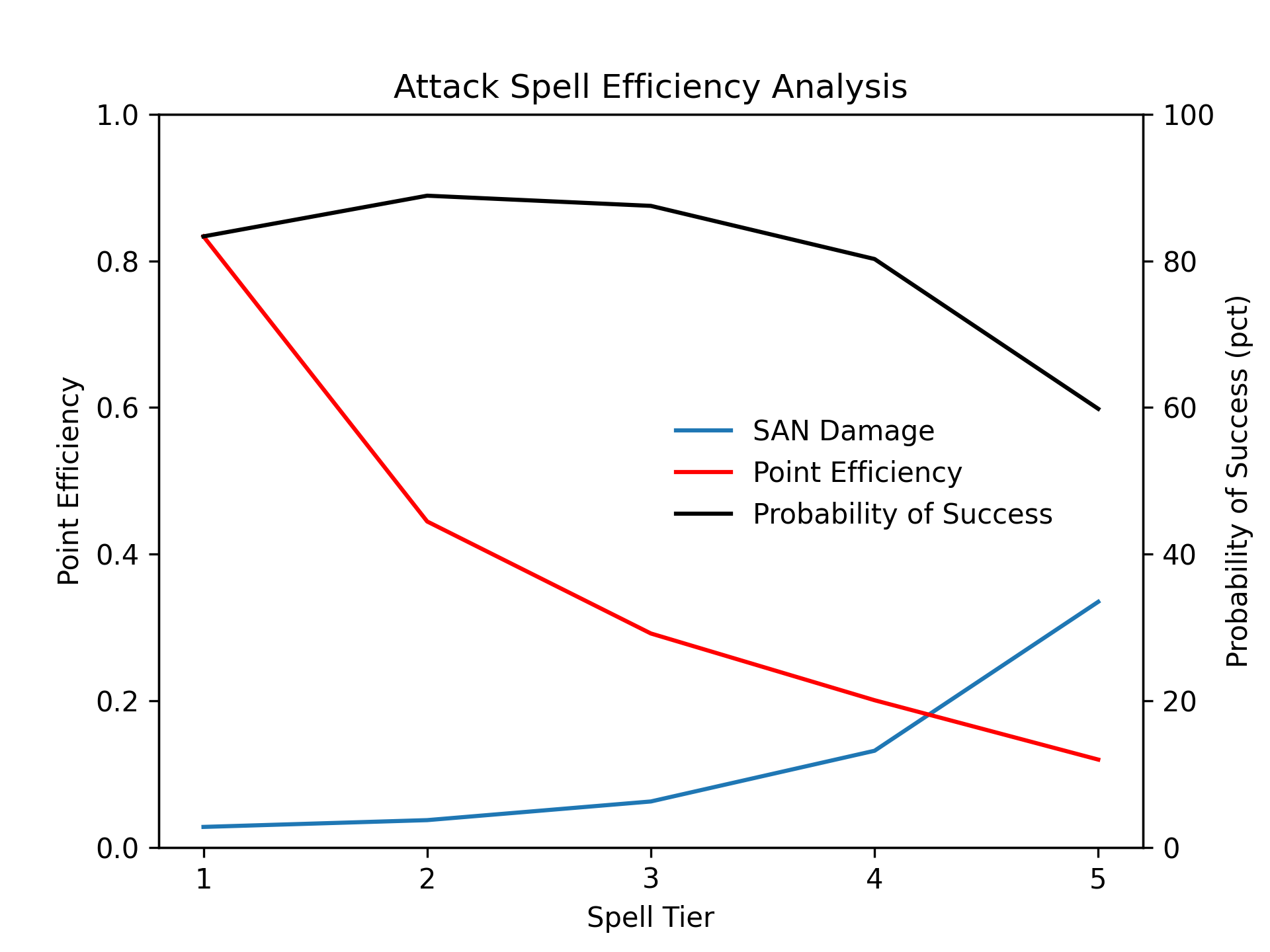
Looking at the efficiency analysis above we see that the probability of success for casting magic based on an attack stays relatively high throughout. Even at 5th tier, the chance of success is about equivalent to an attack with a light weapon. Unlike a weapon attack, higher tiers of magic are accompanied by increasing risk of taking significant Sanity damage, so I think this relatively high chance of success is balanced by the risk of damage to the user. Point efficiency is pretty good at lower tiers, but decreases with every tier for a generic damage-dealing spell that only deals one point of damage to one target. Modifying the number of targets or the damage dealt will increase the overall point efficiency but will need to be evaluated on a case basis for a given school of magic.
While this chance of success seems high, keep in mind that a target gets the opportunity to dodge and a Health check against the damage, significantly reducing expected damage. Additionally, a generic damage-dealing spell does not benefit from [REND], greatly reducing the efficiency against armored targets. We can now look at the efficiency analysis for a [TARGET] spell.
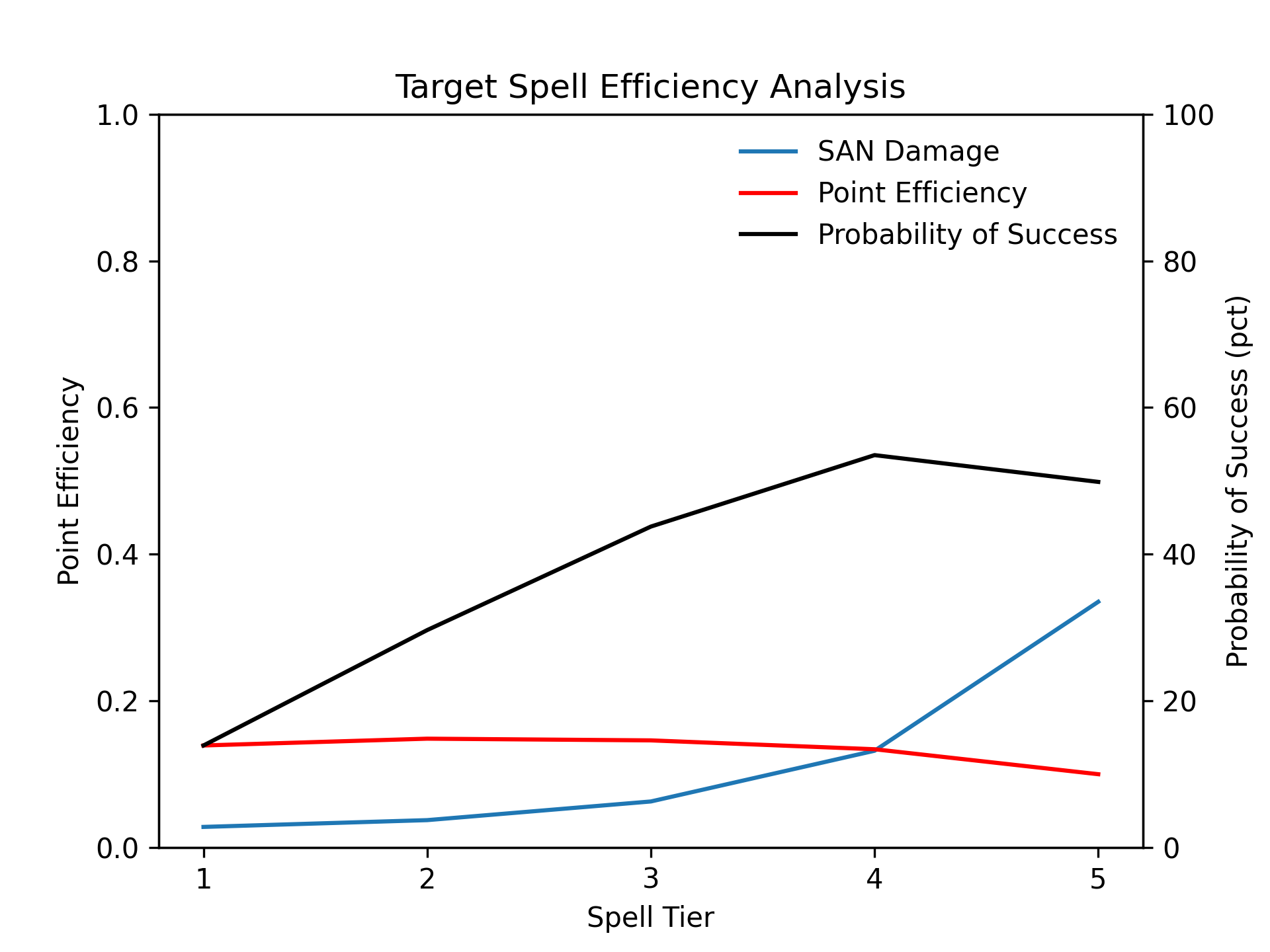
A [TARGET] spell gets more likely to succeed as the tier of spell increases due to the increased save DC, however the point efficiency remains low throughout due to the combined effects of the spellcasting check and the target save. The key benefit of a [TARGET] spell is that it does not allow a dodge check, greatly increasing its efficiency against high dodge targets.
[SPHERE] and [LINE] spells share the same efficiency analysis with [TARGET] spells, with the caveat that each additional target within the area of effect increases the spell’s point efficiency additively, without imposing increased risk of Sanity damage. While this can definitely be powerful in the case of a large area of effect, it is situationally useful and makes [TARGET] based spellcasting more of a tool that highly useful for a specific use case, which I think is a good balance.
Clearly there are a lot of caveats here and each school of magic will need to be individually assessed for balance.
6.3 Summary
In summary:
- All magic comes in schools with five tiers and the effects of each tier stack.
- You can combine schools of magic to add effects from different schools of magic in one spell.
- Magica relies on Will and Malika relies on Fortitude
- When casting a spell, make a stacked roll as a spellcasting check against a DC equal to the total tier of magic plus one. Roll a number of dice equal to the total tier of magic. On a failure, take one point of Sanity damage (Magica) or one point of Health damage (Malika) for each result of a one.